
https://doi.org/10.25547/0FYE-WM21
Lisez-le en français
This insights and signals report was written by Lucía Céspedes, Suzanne Beth, Simon van Bellen, Alan Colin-Arce, Britt Amell, and Ray Siemens with thanks to INKE Partners Christianna Brooks and Jeanette Hatherill for their comments and review.
Photos: Liv Mann Tremblay, conference photographer
At a Glance
| Topic / Titre | Recap of the 1st Canadian Conference on Open Science and Open Scholarship |
| Key Participants / Créateur | Érudit, PKP, INKE, Digital Research Alliance of Canada, Federation for the Humanities and Social Sciences, Tri-Agency (CIHR, NSERC, SSHRC), Fonds de recherche du Québec |
| Date / Période | 2025 |
| Keywords / Mots-clés | Canada, open science / science ouverte, open social scholarship / approches sociales des savoirs ouverts, policy / politique, open access / libre accès, open data / données ouvertes, open infrastructure / infrastructure ouverte, events and gatherings / événements et rassemblements, funding agencies / organismes de financement |
Summary
This insights and signals reports on the First Canadian Conference on Open Science and Open Scholarship.
Items discussed in this report include:
- Participation of INKE partners in the First Canadian Conference on Open Science and Open Scholarship
- Key takeaways from the event
Mapping the Present, Charting our Future
Open Science seems to have taken the scientific world by storm. Declarations, policies, and mandates are almost ubiquitous across research funding and performing institutions worldwide. Given the broad scope of practices included under the “umbrella term” open science, it can be difficult for researchers, even those genuinely interested and motivated, to keep track of the movement in their own discipline and country. The First Canadian Conference on Open Science and Open Scholarship was a welcome initiative in assembling key stakeholders that, sometimes, work in parallel rather than together.
Hosted by Concordia University in Montréal with support from the Social Sciences and Humanities Research Council and eleven partner institutions (including INKE partners Érudit, Public Knowledge Project, Coalition Publica, and the Digital Research Alliance of Canada), the event brought together almost 200 participants from government, academia, and research organizations from across Canada. In this sense, the event successfully integrated scholars and practitioners who are, by the very nature of their work, specialized in OS (such as those from the fields of library and information sciences) and practitioners with colleagues from other disciplines who nonetheless have adopted and advocate for openness in their laboratories and departments. Over two activity-packed days on October 9th and 10th, 2025, they shared experiences and insights about how they have integrated open science practices in their everyday work, often with a rather practical approach. Topics included open access publishing, open data preservation and management, incentives and evaluation of open science, open infrastructures, financial support, and, overall, changing the culture of research in Canada towards more accessible, transparent, and collaborative practices.
INKE partners were busy and engaged in all kinds of presentations throughout the conference. After opening remarks from Concordia University President Graham Carr and keynote speeches from the Chief Science Advisor to the Government of Canada Monica Nemer, the Chief Science Advisor to the Government of Québec Rémi Quirion, and conference hosts Nicolás Alessandroni and Krista Byers-Heinlein (Concordia University Research Chair in Bilingualism and Open Science), it was time for the booths and posters session. These formats allowed participants to showcase many different open science initiatives, from traditional research results to institutional projects, in an interactive and relaxed manner.
Lucía Céspedes, research advisor at Érudit, together with Adrien Savard-Arseneault of Université de Montréal, presented the results of a narrative literature review commissioned by the Circé Network on open peer review. The study also included a survey among Canadian journal editors on their peer review models and practices. Furthermore, Jeanette Heatherill, Sonya Betz and Kate Shuttleworth, from Coalition Publica, the partnership between Érudit and the Public Knowledge Project (PKP), showed their efforts in advancing research dissemination and digital scholarly publishing in Canada and how they work alongside libraries to lead the Canadian transition to Diamond Open Access, especially within the social sciences and humanities. In a nearby booth, University of Victoria’s Brittany Amell, Alan Colin-Arce and Ray Siemens introduced attendees to the HSS Commons, a platform for open scholarship in Canada (and beyond!) where scholars in the social sciences and humanities can share resources, preserve documents in an open repository, collaborate on shared projects, interact in a forum, and build community.
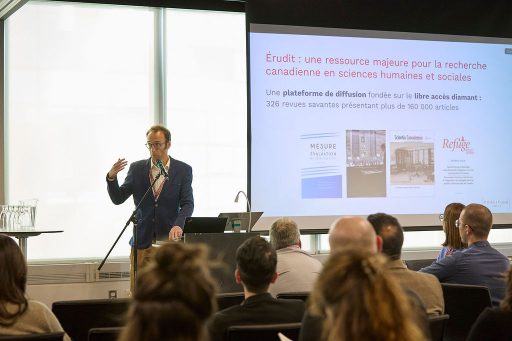
The pace of the conference did not let up, and after lunch break, parallel sessions of lighting talks and panels took place. Céspedes then discussed the role of open digital research infrastructures in the support and promotion of multilingual science, focusing on the multilingual examples of Érudit and PKP’s Open Journal Systems. Kate Shuttleworth posed a provocative question: are scholars’ publishing choices fueling the crisis in scholarly journal publishing? In her talk, Shuttleworth highlighted that scholars and institutions have agency to support diamond OA journals and to shift funds from APCs to open infrastructures. Simon van Bellen, senior research advisor at Érudit, discussed the emerging tensions around opening up textual data in the humanities and social sciences, and specifically challenges posed by big companies harvesting data for generative AI.
While lightning talks were praised for their dynamism, panels allowed for more detailed expositions. Victoria Smith, from the Digital Research Alliance of Canada, discussed the Alliance’s work towards connecting Canada’s research data ecosystem, particularly through the Canadian Research Data Platform and Data Spaces initiatives. Echoing the issues riddling commercial driven OA models diagnosed earlier by Shuttleworth, Heatherill made a powerful call to reclaim ownership of the means of scholarly publishing, discussed the role of national policy, and advocated for diamond open access as the most equitable path forward.She highlighted Coalition Publica’s work in that regard, particularly through Érudit’s Partnership for Open Access program, which provides financial support to 280 scholarly journals, over 200 of which are diamond OA.
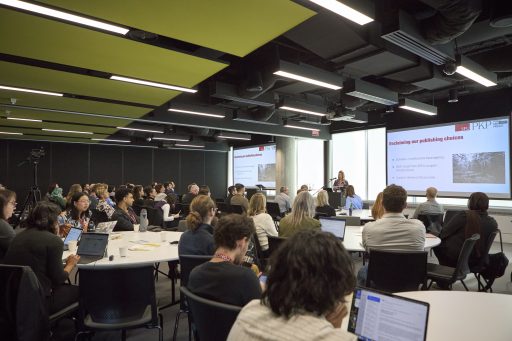
On the second day of the conference, an important round-table featuring funding agencies took place. The first presentation, by Dominique Roche from SSHRC and Jeremy Geelen from CIHR, focused on the Tri-Agency Research Data Management Policy and emphasized the relevance of RDM to advance research integrity and efficiency. Next, Leigh-Ann Coffey from NSERC presented the latest updates on the ongoing revision of the Tri-Agency Open Access Policy on publications. Finally, Emmanuelle Lévesque, from the Fonds de recherche du Québec, also discussed FRQ’s mandates for open access publishing. The dialogue provided an interesting counterpoint between these funders’ initiatives to make research more open, and hinted at some of the pathways the Tri-Agency might follow in its revised policy, although no implementation date was confirmed.
Later that day, working groups on the topics of Infrastructure and Workflows for Open Data, Merit Structures for Open Science, Strategies for Open Access Publishing, Funding Open Science, and Changing the Culture of Research in Canada were gathered. These working groups had already begun their brainstorming the previous evening during the reception and dinner at McGill Faculty Club. In the Workflows for Open Data working group, there were discussions about the importance of having templates for research data management plans specific to specific disciplines and even specific methodologies, such as survey research. Open Publications were discussed in a separate group. Among the emerging ideas, we heard an interesting idea to shift the concept of prestige in publishing: instead of attributing prestige to a journal according to its publisher, we should aim for more viable journals being managed from within universities. This way, journal credibility and quality, rather than prestige, could become a responsibility of a non-profit organization.
During the panel session, Christianna Brooks, from the Federation for the Humanities and Social Sciences, brought her attention to open access books in Canada. Open book publishing is an often neglected aspect of open access debates, which tend to privilege journal articles; nevertheless, books remain a privileged vehicle for the dissemination of research in the social sciences, and especially the humanities.
After the last panel, Alessandroni and Byers-Heinlein revealed an artistic impression by the conference illustrator of what the Canadian open science and open scholarship landscape looks like at present. Current established and challenging areas, as well as potential for future improvement and ways forward, were beautifully illustrated overlapping the country’s geography. This first pan-Canadian, cross-disciplinary and intersectoral conference surely represented a step towards such a future, where careful, situated openness is incorporated in the design, the norm, the practice and the culture of Canadian research.
At the INKE Partnership, we hope to continue these discussions at two upcoming events: the 7th Annual Gathering of the Canadian Australian Partnership for Open Scholarship (CAPOS), happening on December 2nd and 3rd at the Australian National University in Canberra, and at the 2026 INKE conference – the 13th year of these gatherings (see here for details) – taking place in Montreal on June 4th and 5th. More details about the INKE conference will be announced soon.
Responses from the INKE Partnership
Christianna Brooks (Program Officer, Federation for the Humanities and Social Sciences):
Designing open access only around journal publishing disadvantages all researchers, with acute impacts on HSS scholars who rely on books to develop comprehensive arguments and convey nuanced ideas. When books are not meaningfully supported, access to critical scholarship narrows and the diversity of voices needed for robust democratic debate is diminished.
Jeanette Hatherill (Senior Coordinator for Coalition Publica):
This conference was a unique opportunity to bring together a wide variety of colleagues who support open scholarship in Canada. From students and faculty to practitioners and researchers, from long-standing initiatives to new start ups, the mix of perspectives brought a distinct energy to ongoing discussions around open scholarship and open science. With many members of the Coalition Publica team present, we were pleased to be able to showcase some of the range of our activities dedicated to advancing diamond open access as the most sustainable and equitable path to a more open future. Building on the momentum of these conversations, we look forward to continuing our collective work to reclaim research as a public good and hope that future gatherings continue to seek out multiple perspectives that represent the breadth of contributors to this vibrant ecosystem.